How to Fix Slanting Edges & Curling in Mosaic Crochet (Tension & Hook Size Secrets)
Is your mosaic blanket slanting into a parallelogram or curling like a taco? Discover the technical reasons behind tension distortion and 4 quick fixes to achieve perfectly straight edges.
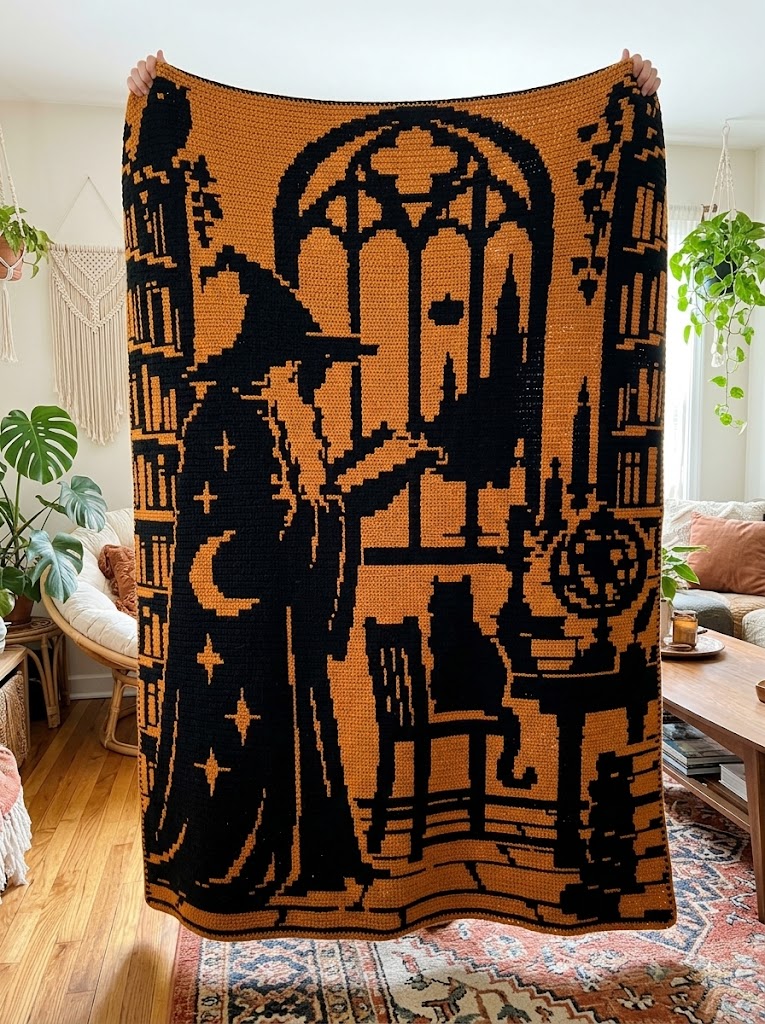
- Technique & Style: Overlay mosaic crochet worked from right to left on right-side rows only, alternating Color A (BLOsc) and Color B (FLOdc drop stitches).
- Zero Ends to Weave In: All side fringe cut tails are completely encased inside a seamless double envelope border worked in the round.
- Included Guides: Full row-by-row written instructions in standard US terms paired with marked high-resolution printable stitch charts.
- Yarn & Gauge: Uses an effortless 50/50 yardage split between Color A and Color B, easily customizable for DK #3, Worsted #4, or Bulky #5 weights.
BLUF (Bottom Line Up Front): Slanting and edge curling in overlay mosaic crochet occur because stitches are worked entirely in one direction without turning, naturally compounding yarn twist. To fix slanting instantly, pull up your FLOdc stitches to full working height, increase your body hook by 0.5 mm, and anchor edge border stitches securely.
Table of Contents
- 1. Why Mosaic Crochet Naturally Slants & Curls
- 2. The "Golden Loop" Elongation Secret for FLOdc
- 3. Hook Sizing Strategy: Foundation vs. Body vs. Border
- 4. Mastering Anchored Border Stitches (BS)
- 5. When Blocking Can (and Cannot) Save a Slanted Blanket
- 6. Troubleshooting Distortion Reference Guide
- 7. Frequently Asked Questions
1. Why Mosaic Crochet Naturally Slants & Curls
In traditional crochet, you turn your work at the end of every row. This alternates the direction of stitch lean, perfectly neutralizing the natural diagonal bias of single crochet stitches.
In overlay mosaic crochet, however, you work every single row from right to left across the front side. Because stitches are never reversed, that tiny natural right-hand lean accumulates across 200 rows, turning what should be a crisp rectangle into an awkward leaning parallelogram. Additionally, working into the back loop only pulls tension toward the rear of the work, causing bottom edges to roll upward like a taco.
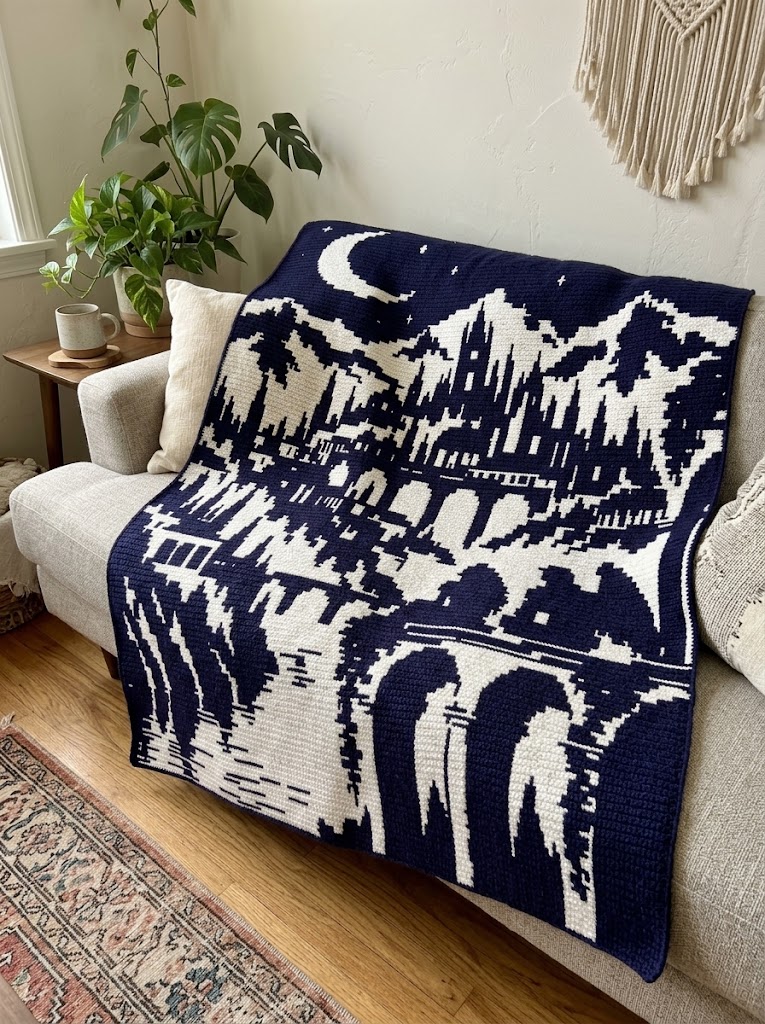
Enchanted Grand Library Bookshelves Blanket
Complex book spine rows and arched library shelves that benefit immensely from proper FLOdc elongation.
2. The "Golden Loop" Elongation Secret for FLOdc
The single most common culprit behind severe slanting is tight FLOdc stitches. When crocheters dip down two rows to grab the front loop, they often fail to draw the yarn loop all the way up to the working height of the current row before completing the double crochet.
When an FLOdc is too short, it acts like a tight rubber band, pulling the fabric diagonally downward and distorting the surrounding stitches. Always lift your hook slightly after drawing up your loop so the top of the double crochet rests level with your current row's single crochets.
3. Hook Sizing Strategy: Foundation vs. Body vs. Border
Pro makers use a three-hook system to guarantee perfectly straight lines:
- Starting Chain: Use a hook 1.0 mm LARGER than your pattern recommends (e.g. 6.0 mm). A loose starting chain prevents the bottom edge from bowing like an archery bow.
- Blanket Body: Use a hook 0.5 mm LARGER than the yarn ball band (e.g. 5.0 mm for worsted weight). This relaxes the Back Loop Only stitches so they do not pinch inward.
- Envelope Border: Drop your hook size by 0.5 mm to 1.0 mm (e.g. 4.0 mm or 4.5 mm) to build firm, crisp perimeter walls that hug the blanket securely.
Hummingbird Heart & Wildflower Blanket
Delicate curved wings and botanical vines requiring smooth tension control to keep floral medallions aligned.
4. Mastering Anchored Border Stitches (BS)
Never work the first or last stitch of a row in the back loop only! Always work border stitches through BOTH loops. Piercing both loops locks the row anchor firmly into place and prevents edge stitches from stretching into sloppy elongated loops when cutting yarn.
6. Troubleshooting Distortion Reference Guide
| Symptom | Root Cause | Instant On-Hook Fix | Preventative Measure |
|---|---|---|---|
| Blanket slanting to the right | Stitch bias & tight FLOdc | Pull up loop to row height | Size up hook by 0.5 mm |
| Bottom edge curling upward | Back-loop tension bias | Work Row 1 through both loops | Double envelope border encasement |
| Side edges waving / ruffling | Too many border stitches picked up | Skip 1 stitch every 8 rows | Drop border hook size by 1 mm |
| Bottom edge smiling (curving in) | Foundation chain too tight | Use foundation single crochet (fsc) | Chain with 1 mm larger hook |
Frequently Asked Questions
Q: Why does working in the back loop only cause curling?
When you work strictly into the back loop, the unworked front loop creates a horizontal ridge across the front of the fabric. The structural tension differential between the front and back surfaces naturally forces the lower edge to curl upwards toward the front.
Q: Should I block my mosaic blanket before or after adding the envelope border?
We strongly recommend doing a gentle steam blocking on the blanket body BEFORE attaching the double envelope border. This relaxes any minor slanting and squares up your side rows, making stitch pickup for the border walls completely uniform.
Q: What is the golden rule of FLOdc stitch elongation?
Whenever you yarn over and insert your hook into the front loop two rows down, pull the loop up until it rests even with the top loop on your hook. Never strangle the yarn down into the stitch, or it will pull the blanket into a diagonal slant.
Q: How tight should my starting foundation chain be?
Your foundation chain should be visibly loose and flexible. We recommend using a hook 1.0 mm larger than your body hook for the starting chain, or substituting the chain with a Foundation Single Crochet (FSC) row for maximum elasticity.
Celebrate your lifelong love for literature with this grand library bookshelves overlay mosaic crochet blanket pattern featuring towering book stacks, ornate ladders, and cozy reading nooks.
Planning to Crochet This Blanket?
Use our Free Crochet Blanket Yardage Calculator to calculate exact stitch counts, row counts, and 50/50 overlay mosaic color splits for any custom size.
Shop Matching Mosaic Blanket Patterns
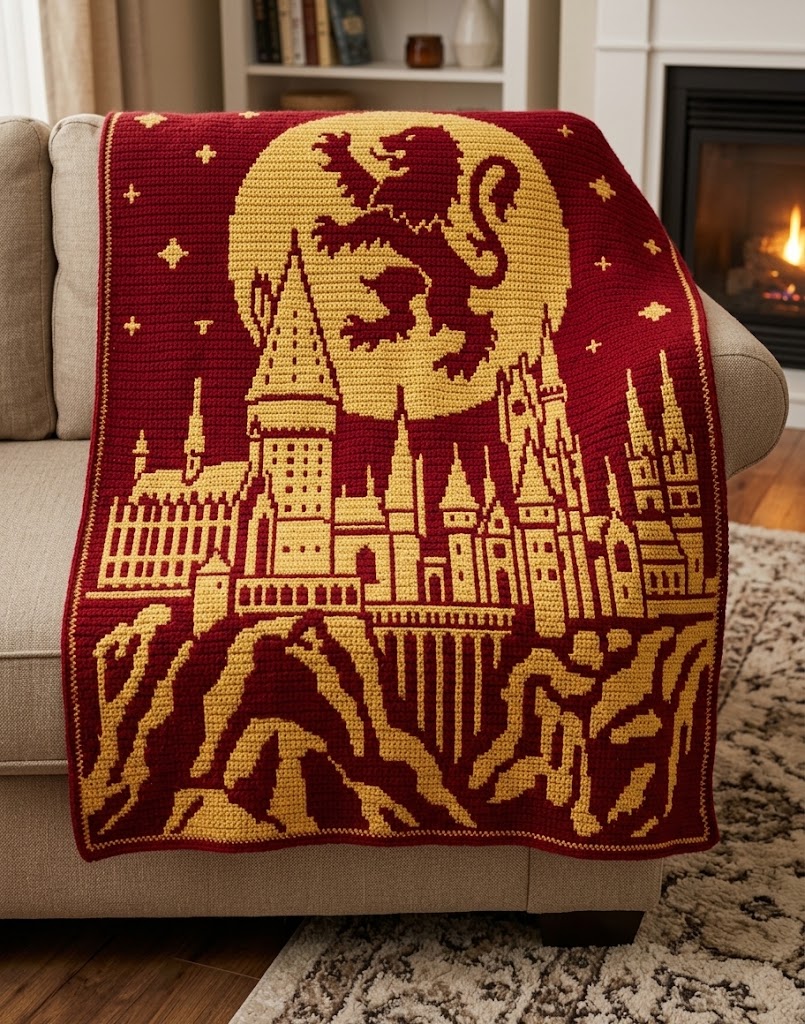
Brave Lion Crest House of Chivalry & Courage Mosaic Crochet Blanket Pattern
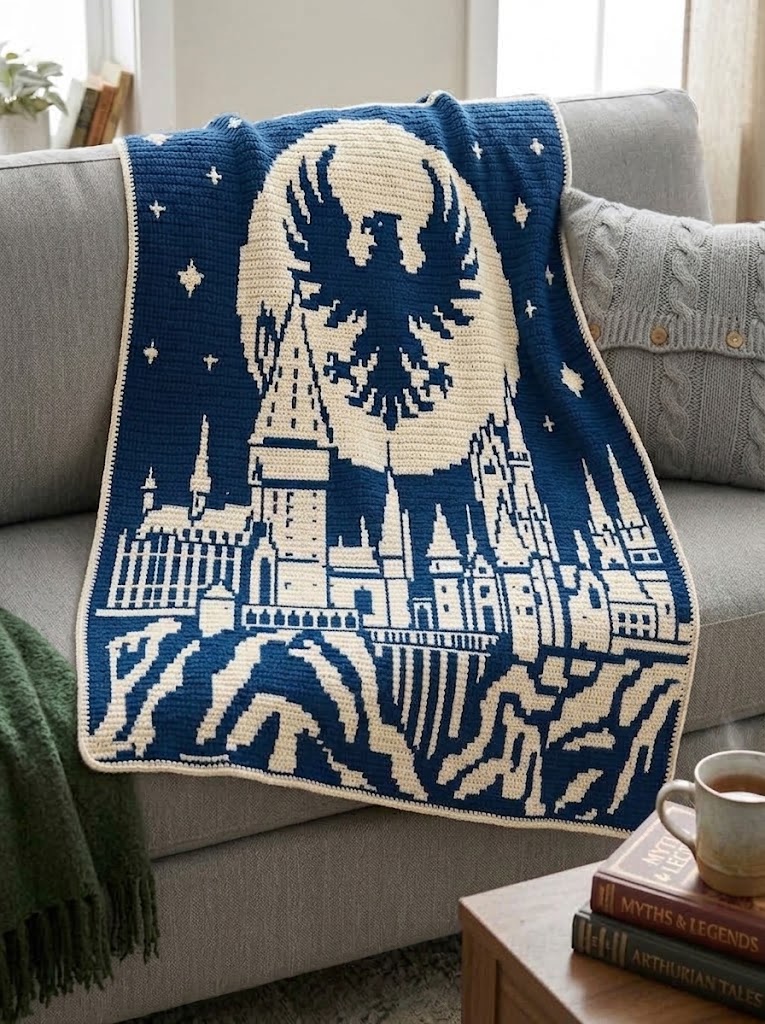
Wise Eagle Crest House of Wit & Bronze Mosaic Crochet Blanket Pattern
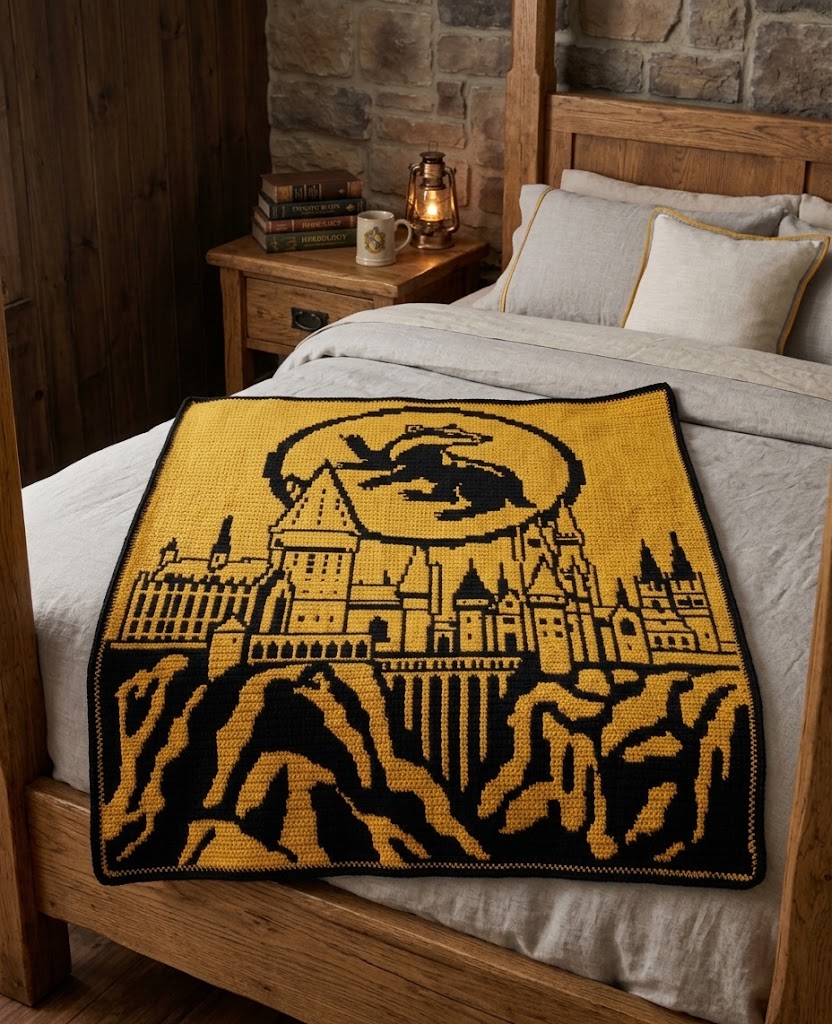
Loyal Badger Crest House of Earth & Gold Mosaic Crochet Blanket Pattern
Related Crochet Tutorials & Guides
How to Steam Block a Large Acrylic Crochet Blanket (Step-by-Step Without Melting)
Transform stiff acrylic stitches into a luxurious, draping heirloom. Learn how to steam block large crochet blankets safely without flattening or melting synthetic fibers.
How to Calculate Yarn Yardage for a Mosaic Crochet Blanket (Color A vs Color B Ratio)
Never run out of yarn mid-project again. Accurately calculate total yardage, estimate Color A vs Color B ratios, and budget for envelope borders with our proven formula.
How to Crochet a Double Envelope Border (Hide All Yarn Tails Without Weaving)
Say goodbye to weaving in hundreds of fringe ends. Learn how to work an elegant double envelope border that encases all raw yarn tails inside a clean double-layered hem.
🔗 Share or Reference This Guide on Your Blog
Are you a crochet blogger, yarn creator, or craft curator? You are welcome to reference or cite this tutorial on your website. Click below to copy a ready-to-use HTML link.
<p>Reference: <a href="https://crochetpinterest.com/blog/how-to-fix-slanting-curling-edges-mosaic-crochet" target="_blank" rel="noopener">How to Fix Slanting Edges & Curling in Mosaic Crochet (Tension & Hook Size Secrets) on crochet pinterest</a>.</p>
[How to Fix Slanting Edges & Curling in Mosaic Crochet (Tension & Hook Size Secrets) on crochet pinterest](https://crochetpinterest.com/blog/how-to-fix-slanting-curling-edges-mosaic-crochet)